
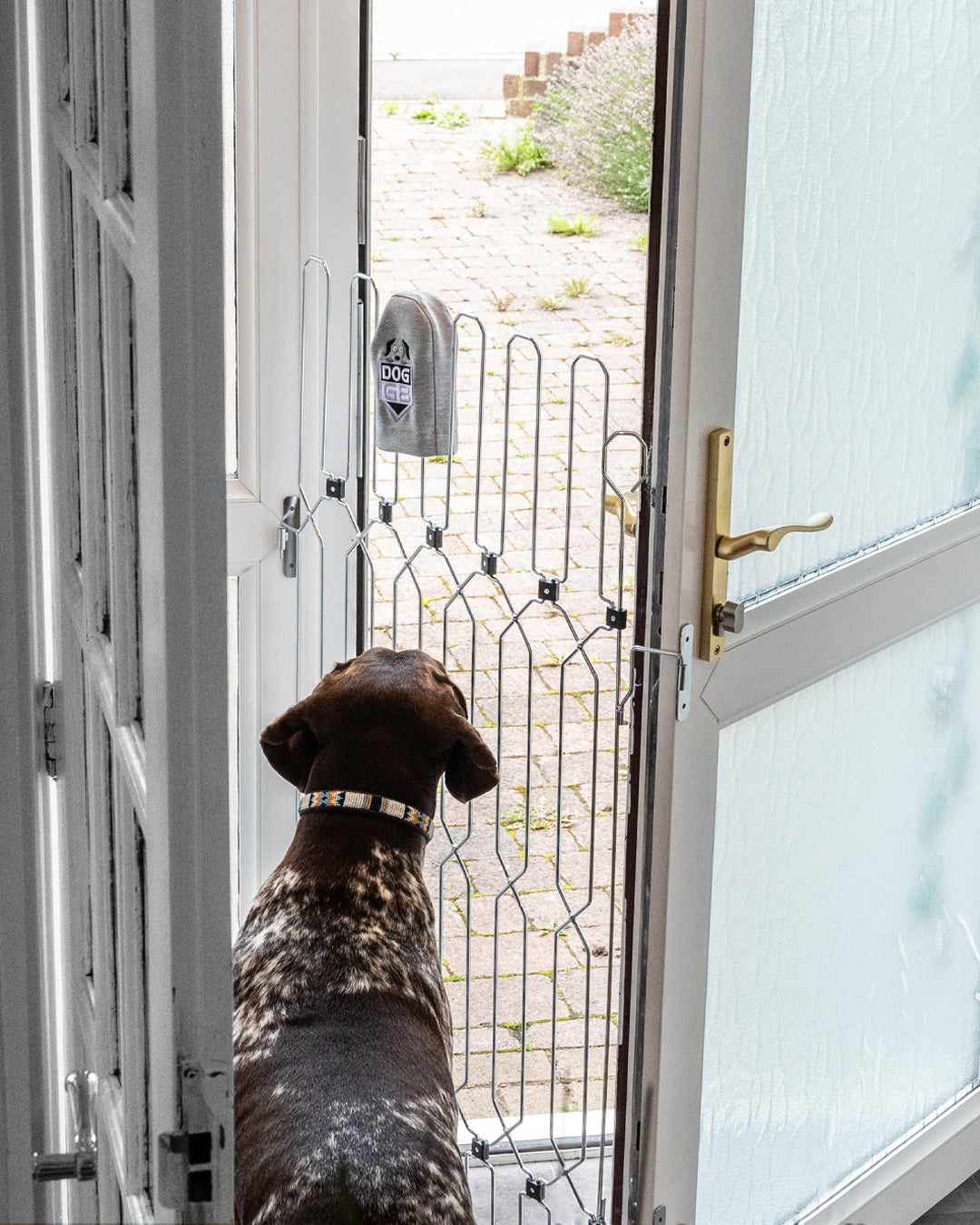

- Dogs may rush through an open front door because of excitement and the opportunity to get outside.
- Training your dog to wait for permission before passing through a doorway can help manage door-dashing behaviour.
- Consistent household routines and a physical barrier can reduce the risk of your dog escaping when the front door opens.
- A front-door dog gate can be particularly useful in open-plan homes where there isn't a separate hallway or internal doorway.
- The best setup depends on your home's layout and your dog's behaviour.
- 1. Why Does My Dog Keep Running Out the Door?
- 2. How to Stop Your Dog Running Out the Front Door
- Train Your Dog Not to Run Out the Door
- Remove the Opportunity for Your Dog to Escape
- Create a Safe Boundary Around Your Front Door
- Secure Your Dog in Another Area of the House
- 3. How Dog-G8 Prevents Dog Door Dashing
Mass hysteria and panic - the dog’s done it again. They’re halfway down the next road, weaving in and out of cars, and you’re chasing after him like a headless chicken.
If your dog keeps running out the door, relying on lightning-fast reactions every single time can quickly become exhausting. Luckily, that’s exactly the kind of problem we at Dog-G8 know a thing or two about.
So, with that in mind, here’s how to stop your dog from running out the front door.
Why Does My Dog Keep Running Out the Door?
If your dog keeps running out the door, it’s usually not because they’re being naughty or ignoring you. That said, it does feel like all the training you’ve been through has gone out the window.
But this behaviour is more common than many owners realise, and it’s actually the exact problem that led me to create Dog-G8.
I saw first-hand how difficult it could be to manage dogs around an open front door. The moment someone arrived, a delivery came, or the door opened, some dogs would become incredibly excited and look for the smallest opportunity to get outside.
I realised the problem wasn’t just training a dog not to run… it was creating a safer environment where excitement didn’t equal escape!
How to Stop Your Dog Running Out the Front Door
That said, the best approach to stopping your dog from running out the front door is a combination of training and management.
Train Your Dog Not to Run Out the Door
Start by teaching them that an open door does not automatically mean “bolt!” A top tip is to practice when there are no distractions, and try the following three steps:
- Ask your dog to sit and wait.
- Open the door or have someone with you open the door.
- Give your pup a treat and reward calm behaviour.
Once they understand what you’re asking, slowly introduce more realistic situations - like opening the door wider, stepping outside yourself, or practicing when someone is approaching.
It’s important you distinguish between never wanting your dog to approach/go through a doorway - but to teach them to wait for permission first.
Remove the Opportunity for Your Dog to Escape
The more chances your pooch has to successfully dash, the more tempting that behaviour becomes. Try to create a consistent routine around the front door:
- Ask your dog to move away before opening it.
- Avoid opening the door when your dog is already highly excited.
- Make sure everyone in the household follows the same approach.
But… real life doesn’t always go according to plan. Unexpected scenarios can occur - so a backup plan also makes a world of difference.

Create a Safe Boundary Around Your Front Door
Sometimes training alone isn’t enough, especially when excitement takes over. This is when creating a physical blocker around the front door may be the best point of call.
A front-door dog gate gives you a clear separation between your dog and the outside world, making it easier to open the door, accept deliveries or welcome visitors without worrying that your dog will slip past you.
This can be particularly useful in open-plan homes where there isn’t a hallway, room or internal doorway that can be used to keep your dog away from the entrance.
If you’re comparing different types of barriers, it’s worth understanding why dog gates and baby gates aren’t always designed with the same challenges in mind.
Secure Your Dog in Another Area of the House
But of course, a front-door barrier isn’t always the best option for every home. The best type of dog gate depends on where you need the boundary and how you use the space.
You may need to create a safe haven elsewhere (think kitchen, living room or hallway) where you can place your dog while you answer the door.
This works well for your overexcited pooches, who sometimes let their giddiness get the better of them. Overall, the best setup depends on your home layout and your dog’s behaviour.
How Dog-G8 Prevents Dog Door Dashing
Dog-G8 helps prevent dog door escapes by creating a physical barrier between your dog and the front door.
Instead of relying on your reactions alone when the door opens, the gate gives your dog a clear boundary to stay behind - whether you’re accepting a delivery, welcoming visitors or simply opening the door.
For dogs that make a beeline for the exit, this means they can’t turn a moment of excitement into an escape.
Dog-G8 can be used directly across the front door or to create a safe area elsewhere in the home, depending on your layout and your dog’s behaviour.
Give your dog a safer boundary at the front door.
Explore the Dog-G8 range and find a gate to suit your home and your dog.