

- Stairs are not automatically bad for puppies, but unsupervised access can create avoidable risks while they are still learning how to move confidently.
- Limiting access to stairs allows you to introduce them gradually rather than letting your puppy practise whenever they choose.
- A secure dog gate can block stair access while also helping create a larger safe space for puppies when you cannot supervise them.
- Look beyond convenience when choosing a gate. Secure locking, suitable placement and a design your dog cannot easily climb are important safety considerations.
- Are Stairs Bad for Puppies?
- Why Can Stairs Be Risky for Puppies?
- When Can Puppies Start Using Stairs?
- How to Stop Your Puppy Using Stairs Unsupervised
- How a Dog Gate Helps with Puppy Stair Safety
- Why Dog-G8 Plus Is a Practical Option
- Dog Gates vs Makeshift and Baby Gates
- Puppy Stair Safety Checklist
- Common Myths About Puppies and Stairs
Puppies move a lot faster than you’d expect.
You turn your back for a second… and suddenly they are at the bottom of the stairs, trying to follow you (looking absolutely adorable) - but without an inkling of a sense of danger.
That is why so many new owners frantically search “are stairs bad for puppies” in a moment of worry.
It is not because they want to stop their puppy from exploring.
It is because they want to know where freedom ends and ultimately risk begins.
The honest answer?
Stairs are not always a bad thing for your pup, but leaving them unsupervised can pose problems - particularly when they’re still trying to find their feet.
Well, paws.
In this guide, you will learn why stairs can be a concern, when to be more cautious, and how a secure dog gate can help create safer boundaries at home.
Are Stairs Bad for Puppies?
Stairs can be bad for puppies when they are used too early, too often, too quickly, or without supervision.
A puppy’s body is still developing.
Their skeletons are not the same as an adult dog's, which means running up and down the stairs can place unnecessary strain on them.
There is also a simple (and very blunt) practical risk:
Puppies are clumsy!
This is considered sweet at times, but when it comes to their safety on stairs, they could slip, tumble, misjudge a step, or try to follow someone before they are ready.
That does not mean every staircase is automatically dangerous… or that your puppy can never learn to use stairs.
The real problem is often not the staircase itself.
It is free access to the stairs before your puppy is ready.
Why Can Stairs Be Risky for Puppies?
Most puppies are naturally curious.
They want to follow you from room to room, investigate new spaces, and be part of whatever is happening at home.
The problem is that curiosity often arrives before coordination.
Extra care may be needed if your puppy is:
- Very young
- Small
- Long-backed
- Large or giant breed
- Nervous on new surfaces
- Overexcited and likely to rush
- Already showing signs of stiffness, soreness, or mobility issues
If your puppy doesn’t look quite right after using the stairs, speak to your vet.
When Can Puppies Start Using Stairs?
There isn’t necessarily a definitive answer to this, as many variables need to be taken into account.
Breed, size, confidence, health, and staircase layout all matter.
A calm puppy on shallow carpeted stairs may cope differently to a tiny puppy facing steep wooden steps.
Before allowing stair use, ask these questions:
- Can my puppy move confidently on different surfaces?
- Are they calm enough to avoid rushing?
- Are the steps suitable for their size?
- Can I supervise them closely?
- Has my vet given any breed-specific advice?
When your puppy is ready, introduce stairs gradually.
Keep it slow, calm, and supervised.
Do not encourage running on the stairs!
Should I Carry My Puppy Up and Down Stairs?
Of course, this is sensible, especially if they are too small or unsteady to manage stairs safely.
However, carrying is not always practical.
Puppies wriggle, grow, and get heavier.
You may also forget to close a door or turn your back for a moment.
That is why a physical barrier is useful.
A dog gate stops your puppy from reaching the stairs when you are not there to supervise.
How to Stop Your Puppy Using Stairs Unsupervised
The simplest way to reduce stair risk is to block access.
Use a secure dog gate at the bottom of the stairs, across a hallway or in a doorway that leads to the staircase.
This stops your puppy from reaching the stairs while still allowing them to use safer parts of the home.
You should also:
- Keep stairs clear of shoes, bags and toys
- Avoid games near the stairs
- Stop your puppy rushing up or down steps
- Supervise any stair practice
- Use calm praise when introducing stairs
- Keep slippery areas restricted
The aim is not to ban your puppy from moving around the house.
The aim is to stop them accessing risky areas before they are ready.
Different homes need different setups, so it helps to compare the types of dog gates before choosing where to block stair access.
How a Dog Gate Helps with Puppy Stair Safety
A dog gate solves one of the biggest problems for puppy owners:
You cannot watch your puppy every second.
A secure gate helps you:
- Block unsupervised access to stairs
- Create a safe puppy zone
- Manage hallways and doorways
- Reduce constant chasing and redirecting
- Keep your puppy away from risky rooms
- Build clear boundaries from the start
Creating a safe puppy zone is something we hear about regularly at Dog-G8.
Not every owner wants to crate train, but they may still want to give their puppy a defined space where they can sleep, settle and stay away from areas like the stairs when nobody is watching.
We’ve seen owners use gates to section off areas such as utility rooms or part of a larger room, giving their puppy more space than a crate while still creating a clear boundary.
“From a puppy perspective, using a gate as an alternative to crate training is something we’ve had a lot of feedback on.”
This is especially useful during everyday moments when accidents can happen quickly, such as answering the door, cooking, carrying laundry upstairs, or working from home.
When choosing a gate for a puppy, look for the key features of a safe dog gate , including secure fitting, suitable height and everyday ease of use.
Why Dog-G8 Plus Is a Practical Option
Dog-G8 Plus is designed for stairways, hallways and doorways, which makes it a relevant choice for puppy owners trying to manage stair access.
It helps by giving you a secure, practical boundary in the places your puppy is most likely to follow you.
Key features include:
- Suitable for stairways, hallways and doorways
- Adjustable width
- Different height options
- Removable when not in use
- Folds to the side to save space
- Durable design for daily use
These features matter because puppy safety needs to fit real life.
If a gate is awkward or constantly in the way, it is less likely to be used.

A practical gate makes it easier to keep stair access controlled every day.
One of the things I particularly like about having a removable, adjustable gate is that your setup can change as your puppy grows.
You might need to block the stairs today, but later you may want the same gate across a hallway, kitchen or another part of the home.
We designed the system so owners aren't necessarily buying a barrier for one specific place and one specific stage of their dog's life.
The setup can be adapted as their needs change.
“You don’t have to just have one gate for life.”
Dog Gates vs Makeshift and Baby Gates
You may ask yourself - why can’t I just use a makeshift barrier like a chair or a box?
But best believe - this isn’t a viable, or long-term solution.
These can be pushed, climbed, chewed, or knocked over.
A proper dog gate is designed to create a clear boundary and stop your puppy reaching the stairs before you can react.
It is also worth knowing the difference between dog gates and baby gates.
Baby gates are another option, and I've always been careful not to suggest that they're inherently bad for dogs.
They serve a purpose.
The important thing is understanding how your puppy is likely to interact with the barrier.
One behaviour we’ve seen with rigid gates is dogs putting their paws on the top and using that solid surface to try to clamber over.
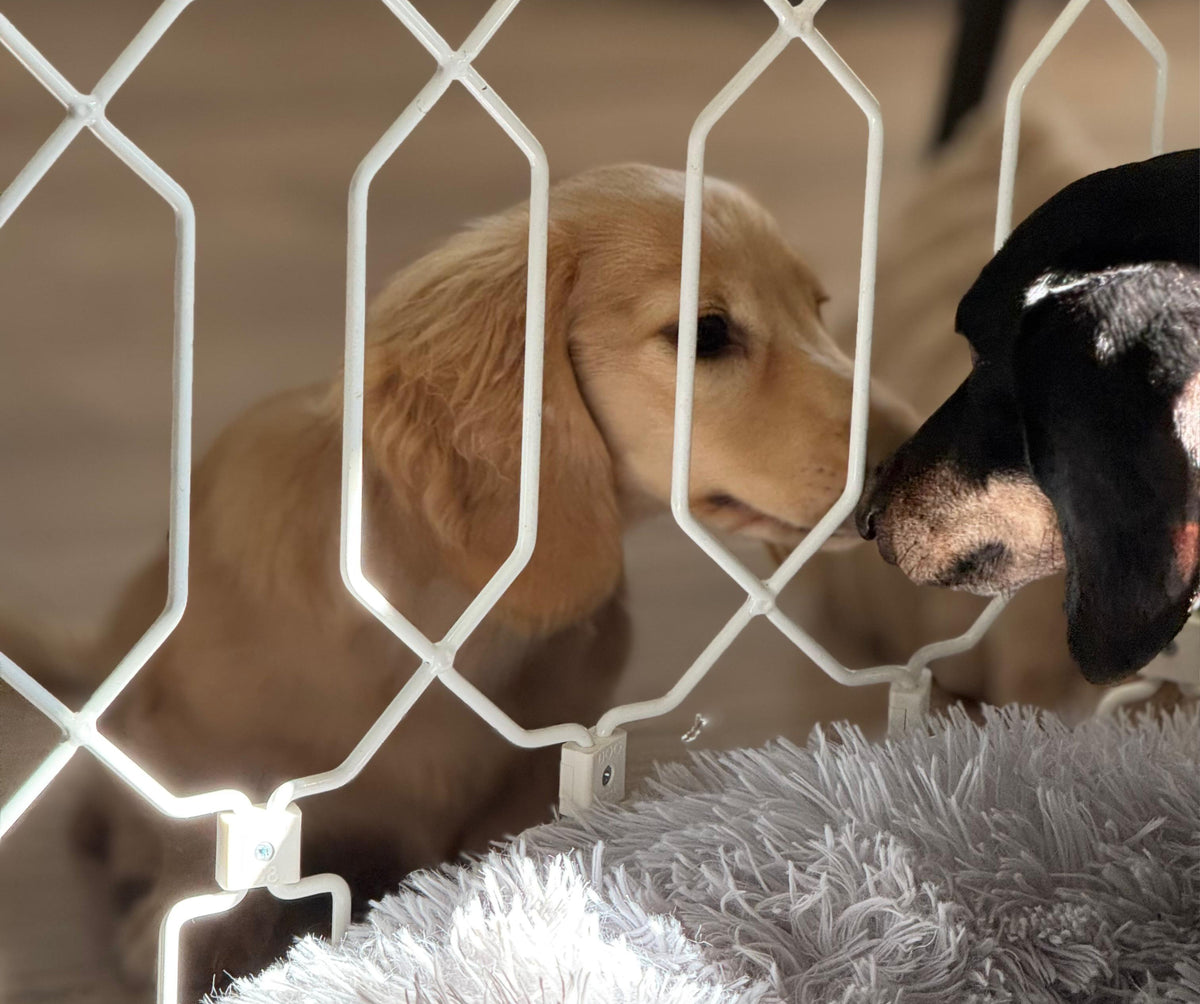
Dog-G8 uses a flexible panel design instead, without the same rigid ledge for a dog to perch its paws on.
It's one of the reasons I'd recommend choosing a barrier based on how a dog actually behaves around it, rather than simply assuming any gate will do.
Puppy Stair Safety Checklist
Use this checklist to decide whether you need a gate or a safer setup:
-
Can your puppy reach the stairs without supervision?
If they can access the stairs when no one is watching, it is worth putting a barrier in place. -
Do they try to follow you upstairs?
Puppies often follow their owners without understanding the risk. -
Are your stairs steep, open or slippery?
Wooden, tiled, open or narrow stairs can be harder for puppies to manage safely. -
Is your puppy very young, small, long-backed or large-breed?
These puppies may need extra care while their body is still developing. -
Does your puppy rush, jump or get overexcited easily?
Fast, excited movement increases the risk of slipping, falling or misjudging a step. -
Would blocking a hallway or doorway stop stair access?
Sometimes the safest place for a gate is not directly on the stairs, but in the hallway or doorway leading to them. -
Do you need a safer setup while cooking, working or answering the door?
A secure dog gate can help protect your puppy during everyday moments when you cannot watch them closely.
If you ticked any of these boxes, stair access should be managed more carefully.
Common Myths About Puppies and Stairs
Myth 1: If My Puppy Can Climb Stairs, They Are Ready
Not always.
Puppies can be bold before they are coordinated.
Being able to climb stairs once does not mean they should use them freely.
Myth 2: Stairs Are Always Bad for Puppies
Stairs are not always bad.
The risk depends on your puppy’s age, size, breed, confidence, health and how often they use them.
Myth 3: Watching Them Is Enough
Supervision helps, but it is not foolproof.
A gate gives you protection for the moments when you cannot watch every movement.
Myth 4: Any Barrier Will Do
A barrier needs to be secure, practical and suitable for the space.
Temporary obstacles are not the same as a proper dog gate.
So, Are Stairs Bad for Puppies?
In conclusion, stairs are not always bad for puppies, but unsupervised access can create avoidable risk while they are still growing, learning, and finding their balance.
The safest approach is simple:
- Limit stair access
- Supervise your puppy around steps
- Use a secure dog gate when you cannot watch them
It ain’t rocket science!
With the right setup, your puppy can enjoy more freedom in safe areas of the home while the stairs stay off-limits until they are ready.
So what are you waiting for - create a safer space for your puppy with Dog-G8.